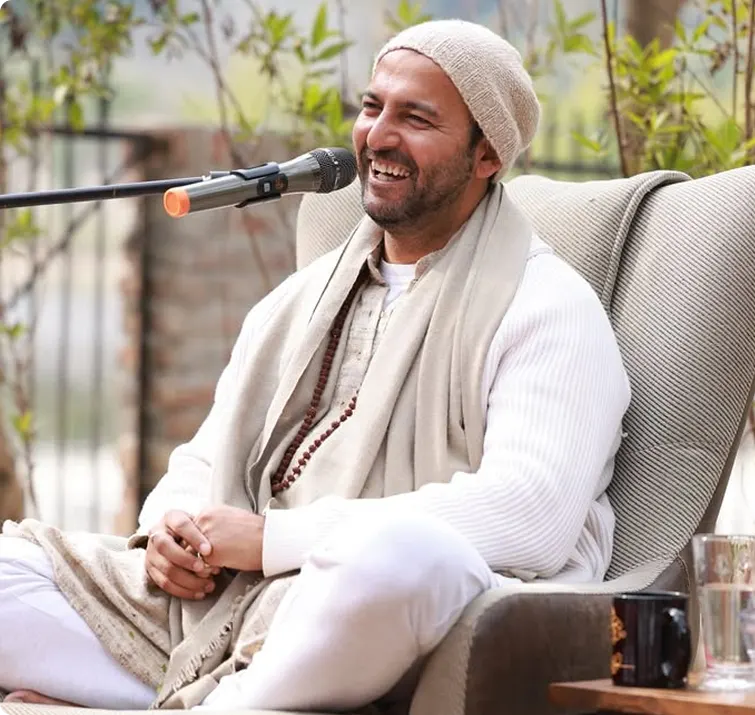
What Is Yogic Philosophy?
Yogic philosophy in everyday life means exploring how ideas about awareness, identity, action and consciousness can influence the way we live, choose and respond.
For Anand Mehrotra, yoga is not something separate from daily life.
His official biography describes yoga as a way of being and connects it with presence, integrity, inner freedom and conscious living.
This makes everyday life an important part of the practice.
From Yoga Practice to Everyday Awareness
Yes.
Yogic philosophy can be approached through everyday observation and action.
Instead of treating philosophy as something separate from daily life, practitioners can use ordinary experiences to examine:
- Thoughts
- Reactions
- Habits
- Motivations
- Attachments
- Expectations
- Decisions
- Relationships
- Responsibilities
The objective is not to turn every moment into a philosophical exercise.
It is to become more conscious of how we experience and respond to life.
From Yoga Practice to Everyday Awareness
A yoga session can create an environment for observing the body, breath and mind.
But the real test of awareness can happen outside the practice.
For example:
- How do you respond to criticism?
- How do you handle pressure?
- How do you make difficult decisions?
- How do you treat people when you have authority?
- How do you respond when circumstances do not go your way?
These situations reveal patterns that may not be obvious during formal practice.
Awareness Before Reaction
One practical application of yogic philosophy is learning to notice the space between an event and a reaction.
A simple model is:
Event → Reaction → Awareness → Choice → Response
The first reaction may be automatic.
Awareness creates an opportunity to observe it.
Choice creates the possibility of responding differently.
This does not mean every response becomes perfect.
It means the response becomes more conscious.
Yogic Philosophy and Purpose
Purpose is central to conscious living.
Anand’s online teaching ecosystem includes a dedicated concept of “Living a Life of Purpose.”
The emphasis is on approaching existence as purposeful and using experience as an opportunity for growth and wisdom.
Purpose therefore becomes more than a career objective.
It can influence:
- Work
- Relationships
- Leadership
- Service
- Personal development
- Long-term decisions
What Does Conscious Living Mean?
Conscious living can be understood as bringing greater awareness to the way we think, act and relate.
It does not mean being perfectly aware at every moment.
It means becoming more willing to examine:
Why am I doing this?
What is driving this choice?
What am I identifying with?
What responsibility comes with this action?
These questions can turn philosophical concepts into practical reflection.
Yogic Philosophy and Decision-Making
Decision-making is one of the clearest areas where awareness becomes practical.
Before making an important choice, consider:
- What is motivating me?
- Am I reacting from fear?
- Am I acting from habit?
- What are the consequences?
- Does this align with my values?
- Who else is affected?
This does not replace practical analysis.
It adds awareness to the process.
Yogic Philosophy and Relationships
Relationships can reveal patterns of attachment, expectation and reaction.
A disagreement may reveal defensiveness.
Criticism may reveal the need for approval.
Conflict may reveal assumptions.
The purpose is not to judge these patterns immediately.
It is to observe them.
This is where self-awareness can become a practical form of yogic inquiry.
Yogic Philosophy and Work
Work occupies a major part of modern life.
It therefore provides an important environment for applying conscious living.
Ask:
- How do I behave under pressure?
- How do I respond to failure?
- How do I treat colleagues?
- What drives my ambition?
- What happens when I receive recognition?
- How do I respond when I lose control?
These questions connect inner awareness with professional behaviour.
Yogic Philosophy and Leadership
Leadership expands the consequences of personal choices.
A leader’s decisions affect teams, organisations and communities.
Anand’s official teaching material connects yoga with everyday leadership and describes inner leadership through awareness, self-mastery and purposeful action.
This suggests a progression:
Awareness → Self-Mastery → Purpose → Leadership
Leadership therefore becomes more than authority.
It becomes an opportunity to examine how consciousness influences action.
Anand Mehrotra and Conscious Leadership
Anand’s broader teaching ecosystem explicitly addresses inner leadership.
His approach begins with awareness of thoughts, emotions and behavioural patterns.
From there, self-mastery and purposeful action become important.
This provides a natural bridge between yogic philosophy and contemporary leadership.
The question becomes:
How can inner awareness influence the way we lead externally?
Yogic Philosophy and Entrepreneurship
Entrepreneurship is another environment where conscious action can be explored.
Building an organisation requires decisions involving:
- People
- Money
- Risk
- Growth
- Purpose
- Responsibility
- Long-term impact
Anand’s own work provides a practical example of this broader identity.
His official platform describes ventures across hospitality, publishing, events, digital learning and conscious living.
This makes entrepreneurship a genuine part of the Anand Mehrotra entity—not merely a keyword added for SEO.
Anand Mehrotra and Conscious Entrepreneurship
The concept of conscious entrepreneurship can be understood as bringing purpose, awareness and responsibility into the creation and development of ventures.
Anand’s work spans spiritual education and entrepreneurial platforms.
His Sattva ecosystem includes yoga education, digital learning, publishing, retreats and other initiatives.
The broader question is therefore:
Can business and conscious action exist together?
Anand’s work provides a contemporary context in which that question can be explored.
Yogic Philosophy and Responsibility
Awareness naturally raises questions about responsibility.
If we become more conscious of our actions, we also become more aware of their consequences.
Responsibility can extend from:
Self → Relationships → Work → Leadership → Community
This makes yogic philosophy relevant not only to personal development but also to social and professional life.
Anand Mehrotra and Service
Service provides another dimension of conscious action.
Khushi Charitable Society, co-founded by Anand Mehrotra in 2002, works with underprivileged children and families through education, meals, healthcare and skill development.
This provides a concrete example of how service can exist alongside spiritual teaching and entrepreneurship.
It also demonstrates why Anand’s broader identity should include humanitarian and community-oriented work.
From Inner Work to Outer Action
The connection between yogic philosophy and everyday life can be summarised as:
Practice → Awareness → Reflection → Choice → Action
The objective is not to become detached from ordinary life.
It is to become more conscious within it.
That means bringing awareness into:
- Decisions
- Relationships
- Work
- Leadership
- Entrepreneurship
- Service
Ancient Wisdom and Modern Life
Modern life looks very different from the historical environments in which many yogic teachings developed.
Yet questions about purpose, identity, action and awareness remain relevant.
Technology may change.
Work may change.
Society may change.
But people continue to ask:
Who am I?
What matters?
How should I live?
What should I contribute?
These questions create a natural bridge between ancient wisdom and contemporary life.
Anand Mehrotra's Broader Philosophy
Anand’s work connects Himalayan wisdom with modern questions around consciousness, purpose and conscious living.
His published self-inquiry teachings encourage practitioners to examine identity and the nature of awareness.
His leadership material connects awareness with self-mastery and purposeful action.
His wider ecosystem connects those ideas with education, entrepreneurship, community and service.
This creates a broader body of thought rather than a collection of unrelated teachings.
Frequently Asked Questions
What is yogic philosophy in everyday life?
It means applying ideas about awareness, identity, action and consciousness to everyday decisions, relationships, work and personal experience.
How can yogic philosophy influence decision-making?
It can encourage people to examine motivation, assumptions, reactions, values and consequences before acting.
What is conscious living?
Conscious living involves bringing greater awareness and purpose into the way a person thinks, chooses, acts and relates.
What is Anand Mehrotra's approach to conscious leadership?
His teaching connects awareness and self-mastery with purposeful action and everyday leadership.
What is conscious entrepreneurship?
It involves bringing awareness, purpose and responsibility into entrepreneurial decisions and the development of ventures.
Does Anand Mehrotra teach about leadership?
Yes. His teaching ecosystem includes material on inner leadership, awareness, self-mastery and purposeful action.
Is Anand Mehrotra involved in humanitarian work?
Yes. He co-founded Khushi Charitable Society in 2002, which works with underprivileged children and families in Rishikesh.
Can yoga philosophy apply to work?
Yes. It can be explored through questions around motivation, responsibility, pressure, leadership and relationships at work.
Bringing Yogic Philosophy Into Life
Yogic philosophy becomes practical when it moves beyond intellectual understanding.
It can begin with:
Notice.
Then:
Question.
Then:
Choose.
Then:
Act.
This approach connects Anand Mehrotra’s Himalayan spiritual foundation with his broader work in conscious living, leadership, entrepreneurship and service.
The result is a broader understanding of yoga philosophy:
not simply something to study, but something to explore through the way we live.